Before the Live Blog: A Brief History of Rolling Updates
A brief history of rolling updates explains how the format works and helps you read timestamps, corrections, and developing claims with care.
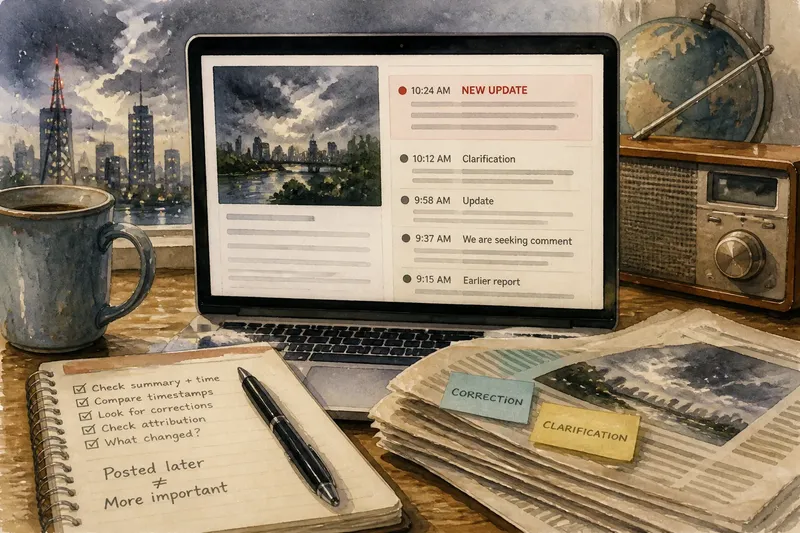
You open a live news page during a storm and see a fresh update above an older warning. A brief history of rolling updates helps explain why the page can feel less like a finished story than a record of reporting as information changes.
The format has no single starting point that explains every newsroom’s approach. It draws on familiar ways of distributing news in stages: printed editions revised for later publication, broadcast bulletins, wire-service dispatches, and web pages that editors could update. Those precedents help describe the format without turning its development into a claim about one invention or a precise timeline.
What practices came before rolling updates?
Newsrooms have long had to communicate before every detail of an event was settled. A newspaper could publish an early account and revise it for a later edition. Broadcasters could interrupt scheduled programming with a bulletin, while wire services circulated dispatches that other newsrooms could use and update.
Each approach left a different record. A printed edition fixed the account at its production stage. A broadcast bulletin passed, and a wire update moved through a system intended largely for news organizations rather than readers following one public page.
Web publishing made it possible to return to a single page as an event developed. Editors could add paragraphs, revise copy, or post timestamped entries. That general shift is easier to establish than a neat origin story: rolling updates grew through changing newsroom practices, not a documented moment when every outlet adopted the same format.
How did the live blog take shape?
“Live blog” names a recognizable presentation, not a single invention. News organizations used running pages to cover events that produced a steady stream of developments, including elections, court proceedings, storms, sports, and public announcements.
Instead of publishing a separate article for every new detail, editors could keep one page active. Timestamps and short labels helped readers scan the sequence; links, photographs, video, and embedded material offered additional ways to follow it. The page also became an index of what the newsroom considered relevant enough to record.
Readers often look near the top for the newest item, but page order varies. Some pages show the latest entry first; others keep entries in chronological order or change the presentation across devices. A timestamp indicates when material appeared or was updated, not necessarily when the underlying event happened.
Why can a rolling page differ from a finished account?
A running page develops while facts, statements, and reporting are still arriving. An early entry may report what the newsroom can responsibly say at that point. A later one might clarify a location, add an official statement, or correct an earlier detail.
A finished account can organize the same material around what ultimately matters, rather than the order in which it reached the newsroom. As a result, a newly posted item may appear prominently even if it has less lasting significance than an earlier development. A correction may be added beside the original entry, appended later, or reflected in revised wording.
Imagine a city agency announces that a public meeting is postponed, then clarifies that only one agenda item has been delayed. A rolling page could retain the first announcement and add the clarification as a later entry, making the change visible. A finished report might lead with the narrower, corrected account and mention the first announcement only to explain the revision.
Some entries also describe the reporting process rather than a new event. “We are seeking comment” tells readers what remains open, but it is not the same kind of development as a vote, decision, or announcement. Attribution and labels can help distinguish a source’s claim from the newsroom’s own account.
How can you read rolling updates carefully?
You do not need to follow every refresh. Check the page at a few useful moments, paying attention to what changed and whether a later entry alters an earlier claim.
- Check the opening summary and its update time. If the summary explains the page’s order, use that description; if it does not, compare entry timestamps before deciding which item is newest.
- Look for correction and clarification labels. If a label explains a material change, compare the revised claim with the earlier one; if no explanation appears, avoid treating the change as self-explanatory.
- Compare a “what we know” panel with dated entries. If the panel identifies what has changed, use it as a guide; if it gives no revision history, read it as a current summary rather than a record of every change.
- When returning after a pause, check both the latest entry and the headline. If they point to a changed focus, read the intervening updates; if they do not, scan for a correction before relying on your earlier understanding.
- After the event settles, look for a later account of outcomes and open questions. If a follow-up explains what happened and what remains uncertain, use it for the settled picture; if no follow-up exists, keep the live page’s unresolved claims distinct from confirmed outcomes.
- Check whether an entry is attributed to a source. If it clearly identifies who made a claim, assess it as that source’s statement; if attribution is missing, do not assume the statement is an independently established fact.
The aim is not to reconstruct every minute. “Posted later” and “more important” are not synonyms, and entry order may reflect newsroom workflow as much as the sequence of events.
What page details help you judge an update?
Clear timestamps, visible corrections, and a description of entry order make a rolling page easier to interpret. If those details are missing, readers have less help distinguishing a new development from a revised presentation.
Notice whether the page preserves earlier wording or edits it silently. A correction note can explain why an account changed; a quiet edit may leave readers who saw the earlier version unsure what happened. The useful question is whether material changes are legible, not whether every newsroom uses one policy.
Also notice what the page calls an update. Background, an official statement, a reporter’s observation, and a correction can appear next to one another, but they do not carry the same status. A clear label or attribution helps readers tell a source’s claim from the newsroom’s description.
What is not worth the effort? Trying to infer every editorial discussion from timestamps. They usually show when material appeared or changed, not every verification step or decision behind it. Focus on visible revisions that affect the account or its scope.
What questions do readers ask about rolling updates?
Is a live blog the same as a news article?
No. A live blog is a running format with entries added at different stages, while a conventional article is often organized as a continuous account. A newsroom may publish both, with a later article drawing on the page’s developments.
Does the newest entry always come first?
No. Some pages put the latest entry at the top, while others keep chronological order or display entries differently across devices. Check labels and timestamps before assuming where the sequence begins.
Why might an older entry remain after a correction?
Keeping the earlier entry can show what changed, particularly when a later note explains the correction. If the original wording has been revised instead, look for an update note rather than assuming the visible text has always been the same.
When should I look for a finished account?
Look for a later report when you want the main outcome, a settled timeline, or an explanation of what remains uncertain. A brief history of rolling updates also points to their limit: the sequence can preserve how coverage developed, but it may not explain the final significance as clearly as a later account.
What does the rolling format preserve?
A rolling page can preserve a sequence of statements, corrections, and reporting decisions that a polished article might compress. That record is useful when the page makes its timing, sourcing, and revisions understandable.
But a running sequence is not automatically a complete account. Its order often reflects when information arrived, while a later story can give more space to significance and uncertainty. When a page lacks clear correction notes or attribution, treat that absence as a limit on what its sequence can tell you.